


Teacher: Astrid Hügli-Frautschi
Meet the teacher
Astrid Hügli-Frautschi
Astrid has a M.Sc. Degree in Electrical Engineering from ETH Zurich. She worked as a development engineer and project leader for 6 years. Later she was a teacher at the Northwestern University of Applied Sciences. She then started a career as a coach and author of textbooks and learning equipment for science courses in primary and secondary schools. Furthermore, she is also an experienced facilitator for “Climate Fresk” (green belt) and leads workshops in schools, Universities and public workshops. Currently, her work is focused on the European climate project “ICOS Cities” (Integrated Carbon Observation Systems) a pilot project to help cities achieve the climate goals of Paris (1.5°C warming) and is responsible for the education program. She also currently combines this work with teaching science courses and coaching teachers in science and climate issues.
Usefull links related to the Solution
Solution website
Solution Resource
Report
Tool
Overview
Climate change is an important challenge for mankind. In order to educate and sensitise young people, Astrid has developed a compact teaching tool with the title: ‘How does CO2 affect Climate Change?’ This was done as part of the Integrated Carbon Observation Systems (ICOS) Cities project.
Theory of Change
The module addresses the shortfall in knowledge and skills related to climate change science which was identified in practising teachers. The module aims to support these in-service teachers with user-friendly teaching resources that allow them to deliver lessons that explain the causes and effects of Carbon Dioxide (CO2) on climate change; and empower students to understand how they can reduce their impact on climate change.
Approach and Actions
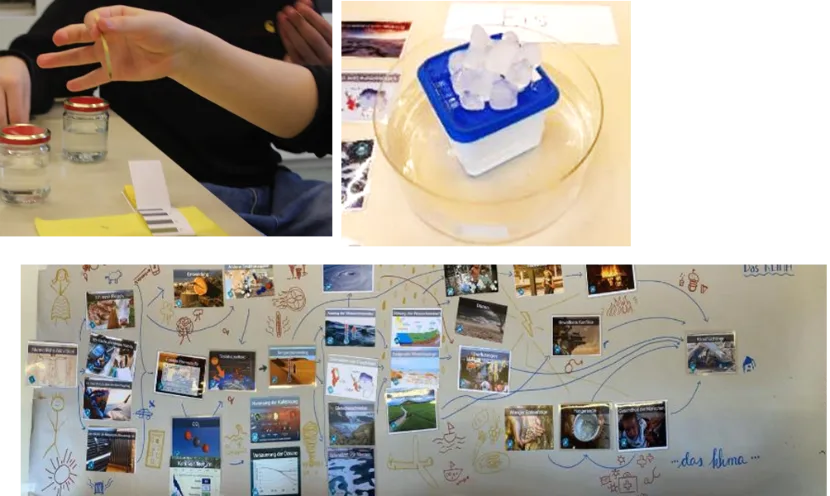
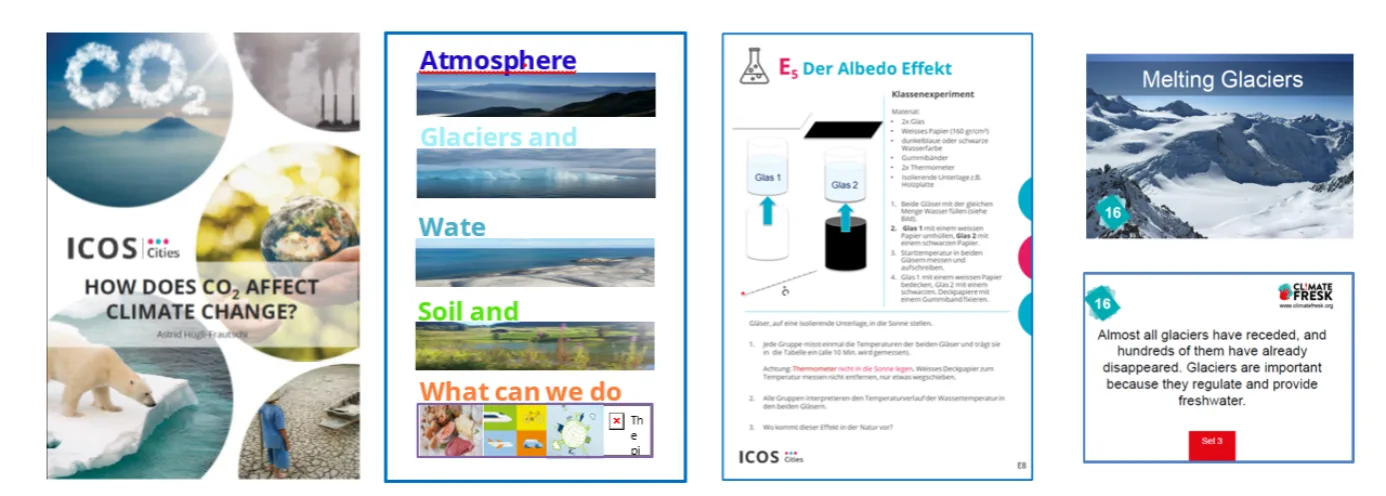
Astrid produced a module consisting of seven lessons – with comprehensive resources for each lesson- which explain the scientific effects of CO2 on climate change. The module consists of the following chapters: Glaciers and Ice, Water, Soil and Vegetation and ‘What Can We Do?’. One or two corresponding experiments are also supplied for each chapter. Cards (showing a picture on one side and a short explanation on the other side) are used to explain the questions in the experiments, these help to explain the reality of the situation that the experiment is demonstrating. The chapter following each experiment allows the students to discuss the facts of climate change and to contextualise the causes of climate change in the environment. At the end of the module, the students’ and teachers’ personal contributions to climate change are discussed, including a call for action in the school.
At the end of the module, Astrid also uses a card game called ‘Climate Fresk’ to help refresh and deepen students’ understanding of the interdependencies found in climate change. ‘Climate Fresk’ is an IPCC-based game, the goal is to link the cards by finding the causes and effects of climate change.
Resources designed to address any knowledge gaps that teachers may have are also provided, teachers have access to a tutorial with pictures explaining the experiments with notes on preparation and materials including a suggestion on how to run the module. Only materials, which are easy to obtain such as glasses, balloons, ice cubes etc. are used for the experiments.
Impact
After designing the module Astrid tested it in a local school, and students and teachers gave their feedback which was mostly positive. Preliminary findings showed that the module is regarded as an easy way to explain the facts of climate change. Students and teachers identified that theory was broken down into manageable sections, for example, the use of a model for the greenhouse effect was well received; also by enriching the module with experiments and a card game the science of climate change was delivered in a fun way that enabled the students to understand the science-based facts and motivated them and their families to take action against climate change. In the next phase, the module will be tested across Zurich in eight classes. The program will then be rolled out in Paris and Munich.